
Dihybrid Cross Calculator

Generate a Punnett square for a dihybrid cross (two traits).

Calculator by SuperCalX: formulas, worked examples and 250+ free calculators.

Your values

Result

ABAbaBab
ABAABBAABbAaBBAaBb
AbAABbAAbbAaBbAabb
aBAaBBAaBbaaBBaaBb
abAaBbAabbaaBbaabb

Phenotype Ratios

  • Dom A, Dom B:9/16 (56.3%)
  • Dom A, Rec B:3/16 (18.8%)
  • Rec A, Dom B:3/16 (18.8%)
  • Rec A, Rec B:1/16 (6.3%)
Dihybrid Cross Analysis
Two-trait inheritance patterns

Independent Assortment

This cross demonstrates Mendel's law of independent assortment. The two traits segregate independently, producing 16 possible offspring combinations.

Classic Ratio

For AaBb x AaBb, the expected phenotypic ratio is 9:3:3:1 (9 dominant-dominant, 3 dominant-recessive, 3 recessive-dominant, 1 recessive-recessive).

Applications

Dihybrid crosses are fundamental in genetics for predicting offspring traits in breeding programs and understanding genetic linkage.

How to Use

Step-by-step instructions
  1. 1Enter the 4-letter genotype for Parent 1 (e.g., AaBb).
  2. 2Enter the 4-letter genotype for Parent 2.
  3. 3View the 4x4 Punnett square and phenotype ratios.

Mendelian Inheritance

A dihybrid cross tracks two traits simultaneously. For heterozygous parents (AaBb x AaBb), the classic ratio is 9 dominant-dominant : 3 dominant-recessive : 3 recessive-dominant : 1 recessive-recessive.
9:3:3:1 Phenotypic Ratio

Variables:

A/aFirst trait alleles
B/bSecond trait alleles

Example

AaBb x AaBb

Inputs:

Parent 1:AaBb
Parent 2:AaBb

Steps:

  1. 1.Gametes: AB, Ab, aB, ab (each parent)
  2. 2.16 offspring combinations
  3. 3.Classic 9:3:3:1 ratio expected
Result:
9:3:3:1 Phenotypic Ratio
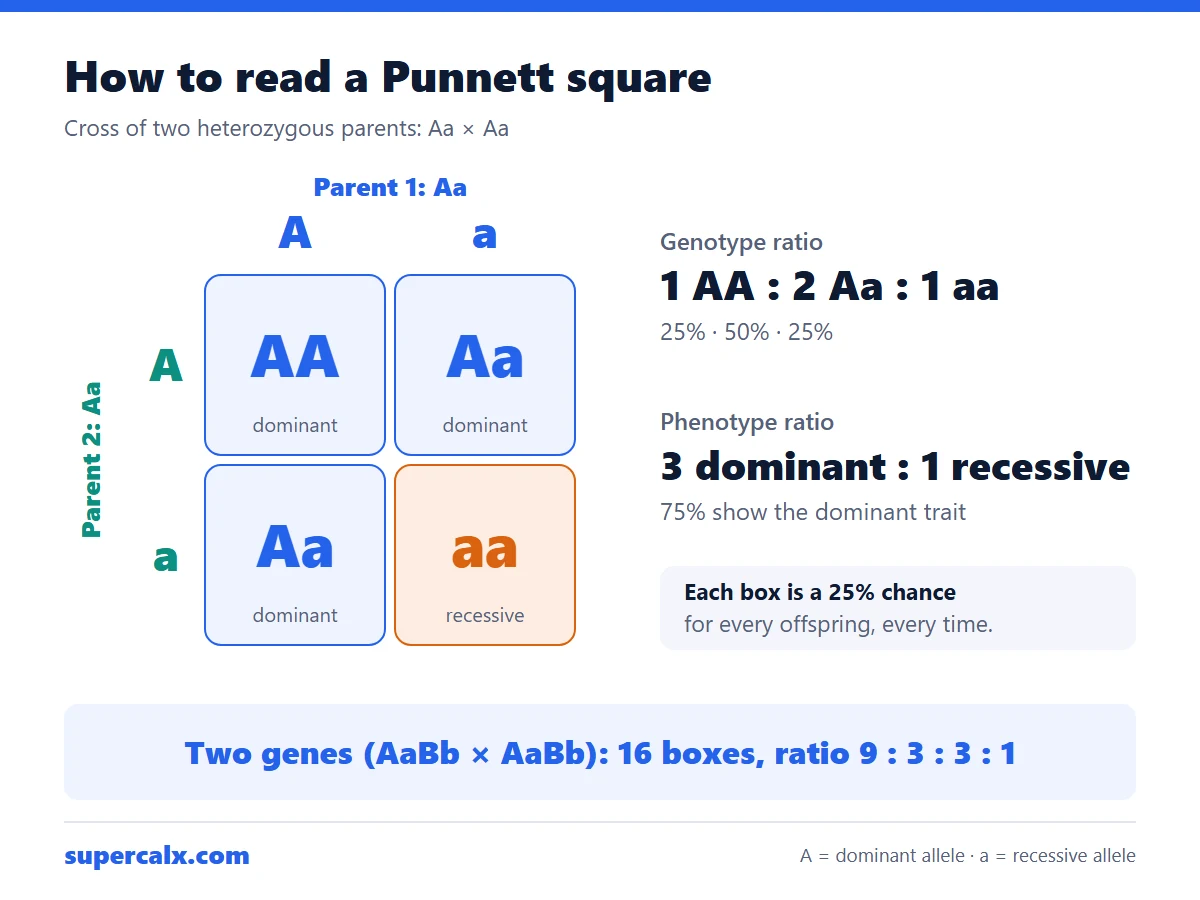
Dihybrid Cross Punnett Square Calculator: the short answer

A dihybrid cross follows two genes at once. Crossing two parents heterozygous for both (AaBb × AaBb) gives a 4 × 4 Punnett square with 16 combinations and the classic 9 : 3 : 3 : 1 phenotype ratio: 9/16 show both dominant traits, 3/16 each show one, and 1/16 shows both recessive traits.

  • Each parent makes four gamete types: AB, Ab, aB, ab.
  • The 9:3:3:1 ratio assumes the genes are on different chromosomes (independent assortment).
  • Linked genes close together on a chromosome break this ratio.

By the SuperCalX team · Reviewed by Dr. Ahmed Mortuza Saleque, founder and editor · Last reviewed · How we check our calculators

Shortcut using probability

Treat each gene separately and multiply. For AaBb × AaBb, P(dominant A) = 3/4 and P(dominant B) = 3/4, so P(both dominant) = 9/16; P(recessive for both) = 1/4 × 1/4 = 1/16. This is quicker than drawing the square and scales to the trihybrid cross.

Mendel's peas

PhenotypeRatioMendel's count (of 556)
Round, yellow9/16315
Round, green3/16108
Wrinkled, yellow3/16101
Wrinkled, green1/1632

Worked examples

AaBb × aabb (test cross)

  1. AaBb gametes: AB, Ab, aB, ab; aabb gametes: ab only.

1 : 1 : 1 : 1 phenotype ratio.

Common mistakes

  • Writing gametes with two copies of the same gene (AA) instead of one allele per gene (AB).

Dihybrid Cross Punnett Square Calculator FAQ

Why is the ratio 9:3:3:1?

It is the product of two independent 3:1 ratios: (3:1) × (3:1).

What is independent assortment?

Mendel's second law: alleles of different genes separate into gametes independently, if the genes are on different chromosomes.

Dihybrid Punnett Square Calculator With Steps

Calculate genotype and phenotype outcomes for a dihybrid cross with clearer structure so two-trait inheritance problems are easier to work through and verify.
  • Best for two-trait inheritance study problems
  • Useful when monohybrid reasoning no longer fits the question
  • Helpful for verifying genotype and phenotype pattern logic

Why “With Steps” Improves This Topic

It also supports content that explains how gametes are formed and why the resulting square becomes larger and harder to reason about mentally.

How To Interpret The Outcome

Use the result to understand expected inheritance combinations under the model, not to assume every offspring group will perfectly match the theoretical ratio. The calculator is most useful as a structured reasoning aid.

Why are dihybrid crosses harder than monohybrid crosses?

Because there are more allele combinations and more gamete possibilities, which creates a larger set of potential offspring outcomes to track.

Do dihybrid ratios always appear exactly in real offspring counts?

No. The ratios are expected probabilities under the model, and real samples can vary, especially when the number of offspring is small.

Add this calculator to your website

Teachers, bloggers and businesses can show the Dihybrid Cross Punnett Square Calculator on their own pages for free. Copy this code and paste it into your page's HTML:

Please keep the credit link so readers can find the formula, worked examples and guide.