
kW vs kWh: What Is the Difference?
By Dr. Ahmed Mortuza Saleque · Updated · How we check our content
The short answer
A kilowatt (kW) measures power: how fast electricity is being used at one moment. A kilowatt-hour (kWh) measures energy: how much was used over time. Energy = power × time, so a 2 kW heater running for 3 hours uses 6 kWh. Your electricity bill charges for kWh, not kW.
Open the Electricity Cost Calculator →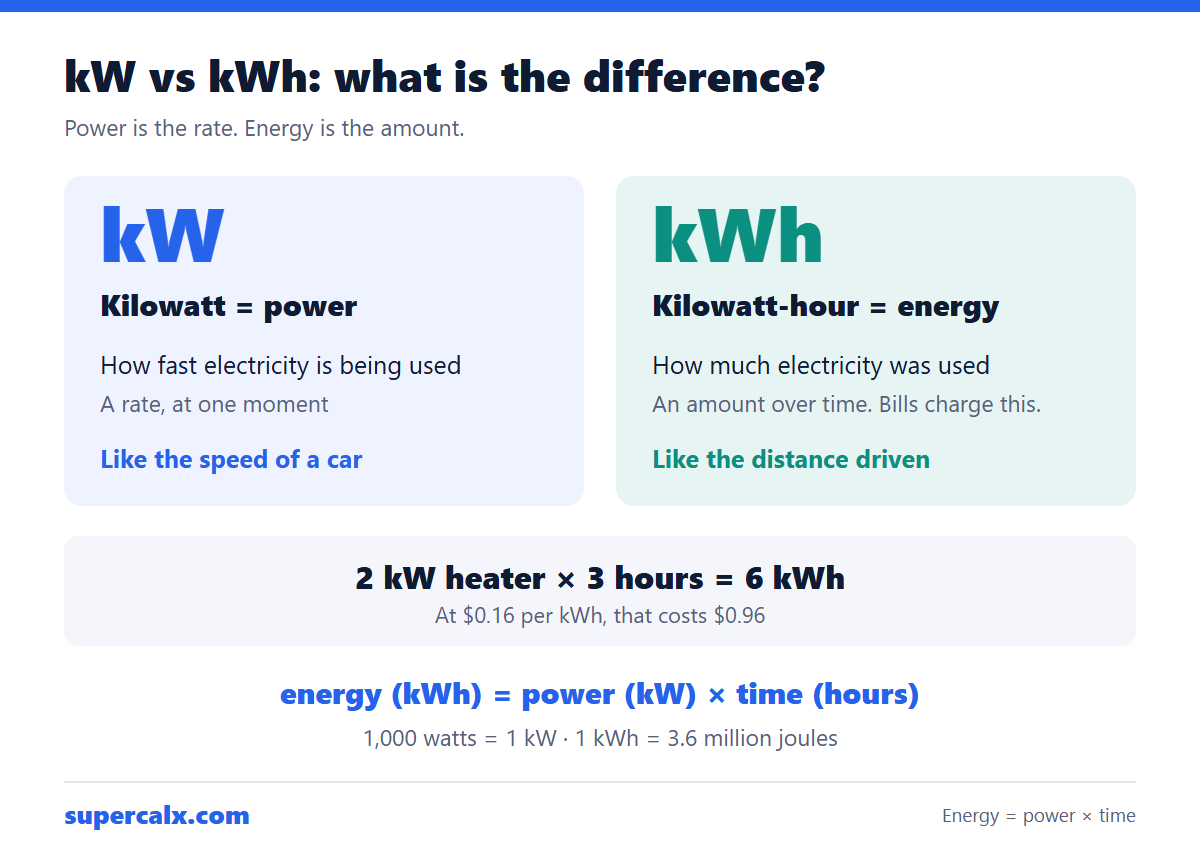
A simple way to picture it
Think of filling a bath. The tap's flow rate is like kilowatts: how fast water arrives. The water in the bath is like kilowatt-hours: how much has arrived. A powerful tap fills the bath quickly; a weak one takes longer to deliver the same amount.
A car works the same way: speed is like kW and distance travelled is like kWh. Driving 60 mph for 2 hours covers 120 miles; running 2 kW for 3 hours uses 6 kWh.
The formula
| You want | Formula | Example |
|---|---|---|
| Energy (kWh) | power (kW) × time (h) | 2 kW × 3 h = 6 kWh |
| Power (kW) | energy (kWh) ÷ time (h) | 6 kWh ÷ 3 h = 2 kW |
| Time (h) | energy (kWh) ÷ power (kW) | 6 kWh ÷ 2 kW = 3 h |
| Watts to kilowatts | watts ÷ 1,000 | 1,500 W = 1.5 kW |
The power calculator handles these conversions, and the energy converter turns kWh into joules, BTU or calories. One kWh is 3.6 million joules.
What 1 kWh looks like
- A 1,000 W microwave running for 1 hour.
- A 100 W television running for 10 hours.
- A 10 W LED bulb running for 100 hours.
- A 2 kW kettle running for 30 minutes.
At $0.16 per kWh, each of those costs 16 cents. See how to calculate electricity cost for a table of common appliances.
On your electricity bill
Homes are billed for energy in kWh. A bill showing 900 kWh at $0.16 is $144 before fixed charges. Some business tariffs add a demand charge based on the highest kW drawn in the month, because the grid has to be built for that peak.
Solar panels, batteries and electric cars
A solar system's size is given in kW: the most it can produce at once. Its output over a day is in kWh. An 8 kW system with 5 peak sun hours produces about 32 kWh a day after typical losses; the solar panel guide explains the sizing.
Batteries are the reverse: capacity is in kWh and the charger's speed is in kW. A 60 kWh car battery on a 7 kW home charger takes about 60 ÷ 7 = 8.6 hours to fill from empty, and costs about $9.60 at $0.16 per kWh.
Common questions
Is kWh the same as kW per hour?
No. A kilowatt-hour is kilowatts multiplied by hours, not divided. "kW per hour" would describe how quickly power is changing, which is rarely what people mean.
How many kWh does a 1 kW appliance use?
1 kWh for every hour it runs at full power. Run it for 4 hours and it uses 4 kWh.
How do I convert kWh to kW?
Divide by the hours. 12 kWh used over 4 hours is an average of 3 kW.
How many kWh does a house use per day?
A home using 900 kWh a month averages 30 kWh a day, which is a steady 1.25 kW around the clock.
Calculators for this article
Sources
More from the blog
- How to Calculate Electricity Cost (kWh Cost per Appliance)
- How Many Solar Panels Do I Need? (By kWh, Bill & Sun Hours)
 Grams to Cups Chart for Flour, Sugar, Butter and More
 How Much House Can I Afford on My Salary?
 How to Calculate Take-Home Pay From Your Salary (2026)
 How Compound Interest Works (With Examples)
 How Much Gravel Do I Need for a Driveway?
 How Much Concrete Do I Need for a Slab?