
How Much House Can I Afford on My Salary?
By Dr. Ahmed Mortuza Saleque · Updated · How we check our content
The short answer
A common lender rule caps housing costs at 28% of gross monthly income. On a $100,000 salary that is $2,333 a month, which supports a home of about $370,000 with 20% down at 6.5% for 30 years, once property tax and insurance are included. Other debts, a smaller down payment or a higher rate all lower the figure.
Open the House Affordability Calculator →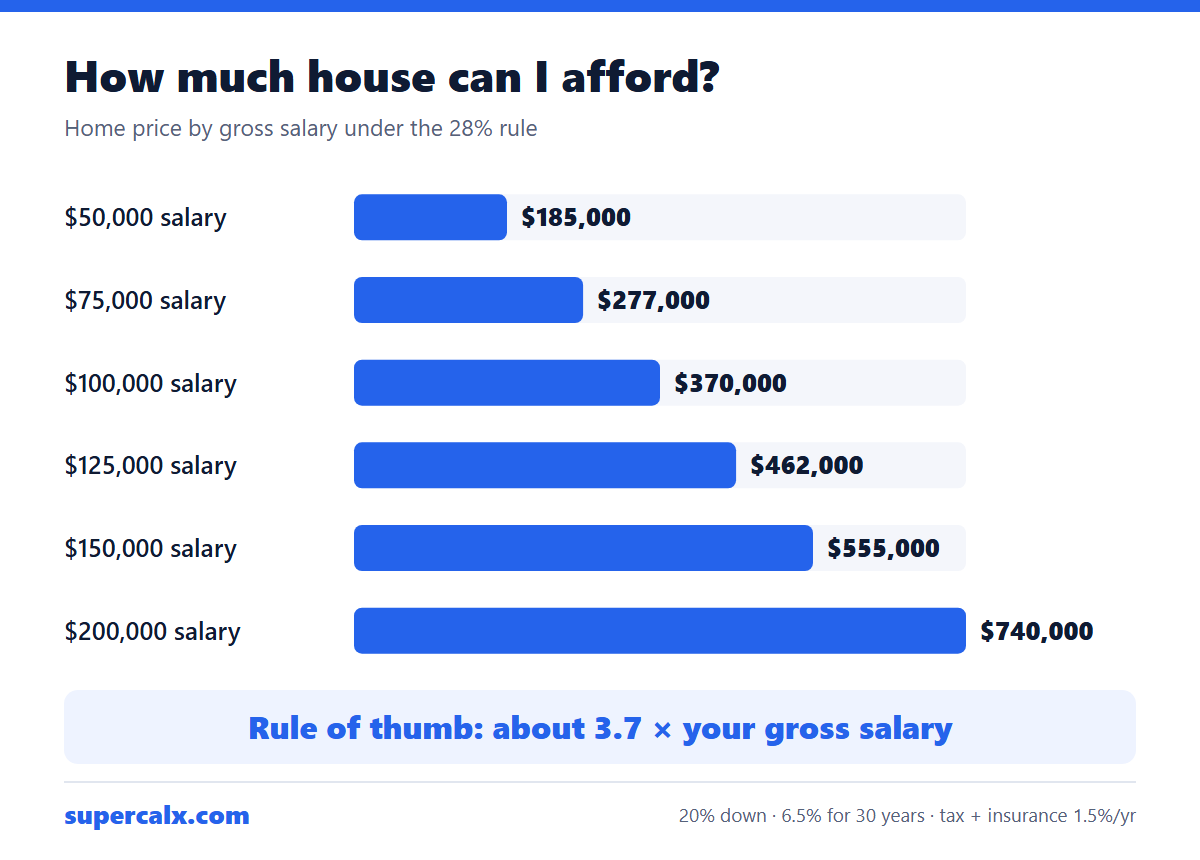
The 28/36 rule
- 28%: your housing payment (loan principal and interest, property tax, homeowners insurance and any HOA dues) should stay at or under 28% of your gross monthly income.
- 36%: housing plus all other debt payments (car loans, student loans, credit cards) should stay at or under 36%.
Your budget is whichever limit is lower. Someone earning $100,000 has $8,333 a month gross: 28% is $2,333 and 36% is $3,000. With $900 a month of other debts, the 36% rule leaves only $2,100 for housing, so that becomes the limit. The house affordability calculator applies both rules.
Home price by salary
Assumes the 28% rule, no other debts, 20% down, a 30-year loan at 6.5%, and property tax plus insurance of 1.5% of the price a year.
| Gross salary | Monthly housing budget | Home price | Loan amount |
|---|---|---|---|
| $50,000 | $1,167 | $185,000 | $148,000 |
| $75,000 | $1,750 | $277,000 | $222,000 |
| $100,000 | $2,333 | $370,000 | $296,000 |
| $125,000 | $2,917 | $462,000 | $370,000 |
| $150,000 | $3,500 | $555,000 | $444,000 |
| $200,000 | $4,667 | $740,000 | $592,000 |
As a rule of thumb under these assumptions, the affordable price is about 3.7 times gross salary.
How the $100,000 figure is worked out
- Monthly budget: $100,000 × 28% ÷ 12 = $2,333.
- Each $1,000 borrowed at 6.5% over 30 years costs $6.32 a month.
- With 20% down, the loan is 80% of the price, so principal and interest cost $5.06 a month per $1,000 of price.
- Tax and insurance at 1.5% a year add $1.25 a month per $1,000 of price, for $6.31 in total.
- Price = $2,333 ÷ $6.31 × 1,000 = about $370,000. The payment is $1,871 of principal and interest plus $462 of tax and insurance.
What moves the number most
$100,000 salary, other assumptions unchanged.
| Interest rate | Affordable home price |
|---|---|
| 5.5% | $403,000 |
| 6.5% | $370,000 |
| 7.5% | $341,000 |
One percentage point of interest changes the price you can afford by about 8%. The down payment matters too: below 20% you usually pay private mortgage insurance, which uses up part of the monthly budget. Property tax varies widely by area, so replace the 1.5% assumption with local figures in the mortgage calculator.
What lenders approve and what is comfortable
The 28/36 rule is a guideline. Some loan programmes approve higher ratios, but approval is not the same as comfort. Before fixing a budget, set aside money for closing costs (often 2% to 5% of the price), moving, repairs, and an emergency fund. This article explains the arithmetic; it is not personal financial advice.
Common questions
How much house can I afford on $75,000 a year?
About $277,000 with 20% down at 6.5% for 30 years, using the 28% rule with no other debts and 1.5% a year for property tax and insurance.
What is the 28/36 rule?
A lender guideline: spend no more than 28% of gross monthly income on housing and no more than 36% on all debt payments together.
Does the 28% include property tax and insurance?
Yes. It covers principal, interest, property tax, homeowners insurance and any HOA dues or mortgage insurance.
How much do I need for a down payment?
20% avoids private mortgage insurance on a conventional loan, which is $74,000 on a $370,000 home. Many loans accept less, at the cost of a larger payment.
Calculators for this article
Sources
More from the blog
 How to Calculate Take-Home Pay From Your Salary (2026)
 How Compound Interest Works (With Examples)
 Grams to Cups Chart for Flour, Sugar, Butter and More
 kW vs kWh: What Is the Difference?
 How Much Gravel Do I Need for a Driveway?
 How Much Concrete Do I Need for a Slab?
 Steps to Miles Chart: How Far Is 10,000 Steps?
 BMI Chart by Height and Weight (Adults)