
How Compound Interest Works (With Examples)
By Dr. Ahmed Mortuza Saleque · Updated · How we check our content
The short answer
Compound interest is interest earned on both your original money and the interest already added. $10,000 at 7% a year grows to $19,672 after 10 years, $38,697 after 20 and $76,123 after 30. With simple interest it would reach only $31,000 after 30 years. The formula is A = P(1 + r)ᵗ.
Open the Compound Interest Calculator →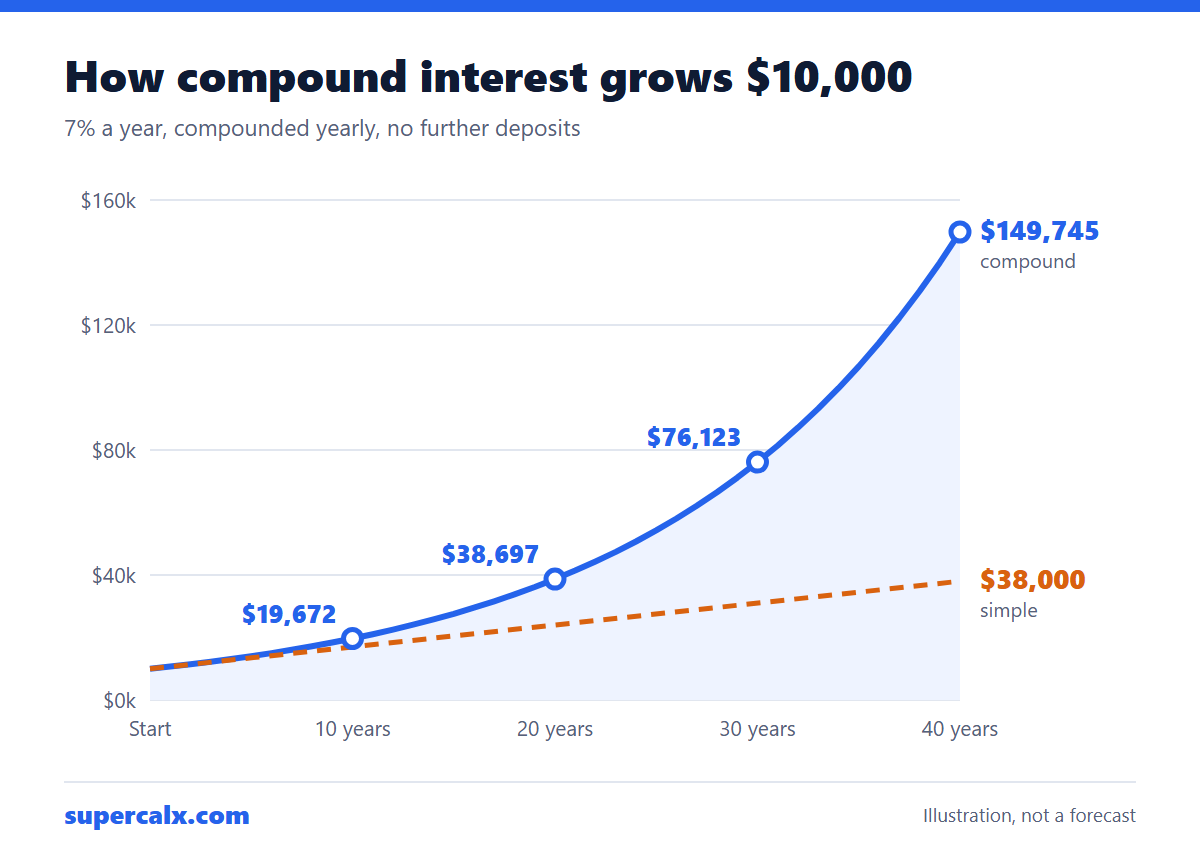
Simple interest and compound interest compared
$10,000 at 7% a year, no further deposits, compounded once a year.
| After | Simple interest | Compound interest | Extra from compounding |
|---|---|---|---|
| 10 years | $17,000 | $19,672 | $2,672 |
| 20 years | $24,000 | $38,697 | $14,697 |
| 30 years | $31,000 | $76,123 | $45,123 |
| 40 years | $38,000 | $149,745 | $111,745 |
Simple interest adds the same $700 every year. Compound interest adds 7% of a growing balance, so the yearly gain itself keeps rising: $700 in year one and about $9,800 in year 40.
The formula
For yearly compounding, A = P(1 + r)ᵗ, where P is the starting amount, r the yearly rate as a decimal and t the number of years. $10,000 × 1.07²⁰ = $38,697.
When interest is added more than once a year, use A = P(1 + r ÷ n)ⁿᵗ with n compounding periods a year. Monthly compounding turns the same $10,000 into $40,387 after 20 years. The compound interest calculator handles any frequency and regular deposits.
The Rule of 72
To estimate how long money takes to double, divide 72 by the interest rate. At 7%, 72 ÷ 7 is about 10.3 years; the exact answer is 10.2. At 4% it takes about 18 years and at 10% about 7.2.
The rule works in reverse too: to double your money in 12 years you need about 72 ÷ 12 = 6% a year.
Regular deposits and the cost of waiting
$300 a month until age 65 at 7% a year, compounded monthly.
| Start age | You pay in | Balance at 65 |
|---|---|---|
| 25 | $144,000 | $787,444 |
| 35 | $108,000 | $365,991 |
| 45 | $72,000 | $156,278 |
Starting at 25 instead of 35 means paying in only $36,000 more, yet the final balance is more than twice as large. Time matters more than the amount. The retirement calculator projects your own figures.
Compounding works against you on debt
The same maths grows what you owe. A $5,000 credit card balance at 22% with no payments would pass $10,000 in about 3.3 years by the Rule of 72. Paying high-interest debt first is usually worth more than any savings rate. Returns on investments are not guaranteed, and the 7% used here is an illustration, not a forecast.
Common questions
What is compound interest in simple terms?
Interest on interest. Each period's interest is added to the balance, and the next period's interest is calculated on the larger amount.
How long does it take to double my money?
Divide 72 by the yearly rate. At 6% it takes about 12 years; at 8% about 9 years.
How much will $10,000 be worth in 20 years?
At 7% compounded yearly, $38,697. At 5% it would be $26,533, so the rate makes a large difference over long periods.
Is monthly compounding much better than yearly?
A little. $10,000 at 7% for 20 years reaches $40,387 compounded monthly against $38,697 yearly, about 4% more.
Calculators for this article
Sources
More from the blog
 How Much House Can I Afford on My Salary?
 How to Calculate Take-Home Pay From Your Salary (2026)
 Grams to Cups Chart for Flour, Sugar, Butter and More
 kW vs kWh: What Is the Difference?
 How Much Gravel Do I Need for a Driveway?
 How Much Concrete Do I Need for a Slab?
 Steps to Miles Chart: How Far Is 10,000 Steps?
 BMI Chart by Height and Weight (Adults)