BMI Chart by Height and Weight (Adults)
By Dr. Ahmed Mortuza Saleque · Updated · How we check our content
The short answer
BMI is weight divided by height squared: kg ÷ m², or lb × 703 ÷ in². For adults, 18.5 to 24.9 is the healthy range, 25 to 29.9 is overweight and 30 or more is obesity. At 5 ft 8 in, the healthy range is about 122 to 164 lb (55 to 74 kg).
Open the BMI Calculator →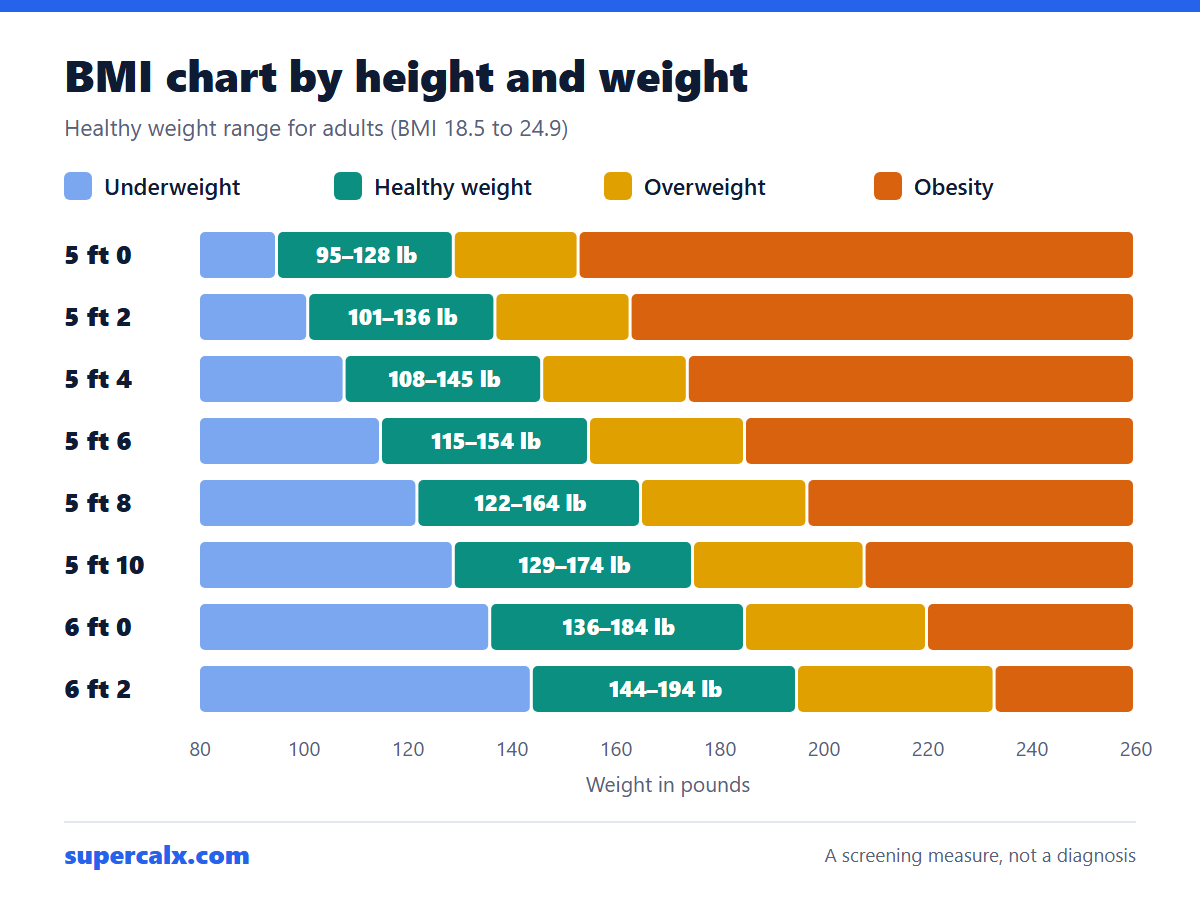
Healthy weight range by height
Adults aged 20 and over. Weights rounded to the nearest pound or kilogram.
| Height | Healthy weight (BMI 18.5 – 24.9) | In kilograms | Obesity starts above (BMI 30) |
|---|---|---|---|
| 5 ft 0 in (152 cm) | 95 – 128 lb | 43 – 58 kg | 153 lb |
| 5 ft 2 in (157 cm) | 101 – 136 lb | 46 – 62 kg | 163 lb |
| 5 ft 4 in (163 cm) | 108 – 145 lb | 49 – 66 kg | 174 lb |
| 5 ft 6 in (168 cm) | 115 – 154 lb | 52 – 70 kg | 185 lb |
| 5 ft 8 in (173 cm) | 122 – 164 lb | 55 – 74 kg | 197 lb |
| 5 ft 10 in (178 cm) | 129 – 174 lb | 58 – 79 kg | 208 lb |
| 6 ft 0 in (183 cm) | 136 – 184 lb | 62 – 83 kg | 220 lb |
| 6 ft 2 in (188 cm) | 144 – 194 lb | 65 – 88 kg | 233 lb |
For an exact figure, enter your height and weight in the BMI calculator.
BMI categories for adults
| BMI | Category |
|---|---|
| Below 18.5 | Underweight |
| 18.5 – 24.9 | Healthy weight |
| 25.0 – 29.9 | Overweight |
| 30.0 – 34.9 | Obesity class 1 |
| 35.0 – 39.9 | Obesity class 2 |
| 40.0 and above | Obesity class 3 |
How to calculate BMI
- Metric: divide weight in kilograms by height in metres squared. 70 kg at 1.75 m is 70 ÷ (1.75 × 1.75) = 22.9.
- Imperial: multiply weight in pounds by 703, then divide by height in inches squared. 170 lb at 69 in is 170 × 703 ÷ (69 × 69) = 25.1.
- Compare the result with the categories above.
What BMI does not tell you
- It cannot tell muscle from fat, so athletes and very muscular people can score as overweight.
- It says nothing about where fat is carried; waist size adds useful information.
- Health risk at a given BMI differs between ethnic groups, and some guidelines use lower cut-offs for people of Asian descent.
- It is not used the same way for children and teenagers, who are assessed with age and sex percentile charts.
- It is less reliable in pregnancy and in older adults who have lost muscle.
To look at composition instead of weight alone, try the body fat calculator.
Using your result
BMI is a screening measure, not a diagnosis. A result outside the healthy range is a reason to talk with a doctor, who can consider blood pressure, blood tests, waist size, family history and how you feel. This article is general information, not medical advice.
Common questions
What is a healthy BMI?
For adults, 18.5 to 24.9. Below 18.5 is underweight and 25 or above is overweight.
What should I weigh for my height?
Use the chart above. For example, at 5 ft 6 in the healthy range is about 115 to 154 lb (52 to 70 kg).
How do I calculate BMI in pounds and inches?
Multiply your weight in pounds by 703 and divide by your height in inches squared. 150 lb at 65 in gives 150 × 703 ÷ 4,225 = 25.0.
Is BMI accurate for muscular people?
No. Muscle is dense, so a lean, muscular person can have a high BMI. Body fat percentage or waist measurement is more informative in that case.
Calculators for this article
Sources
More from the blog
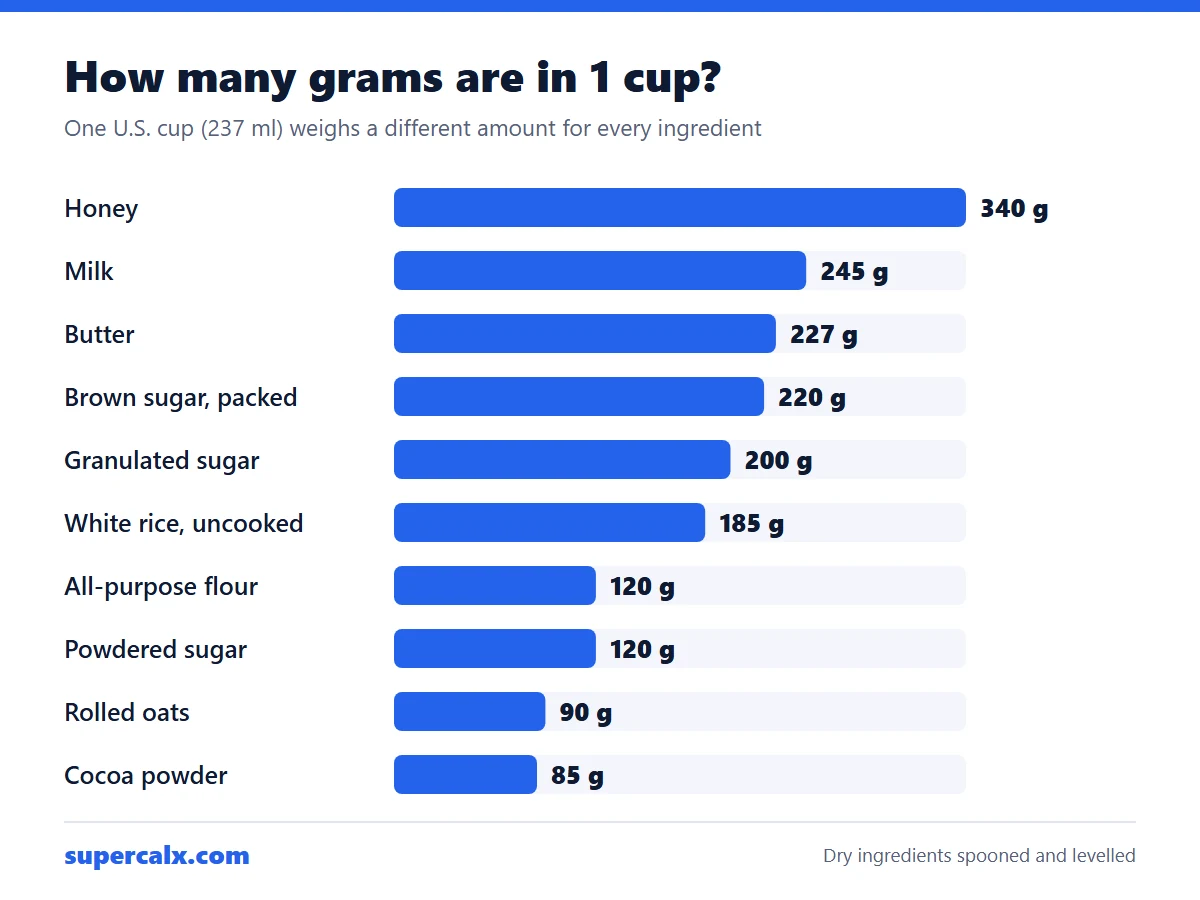 Grams to Cups Chart for Flour, Sugar, Butter and More
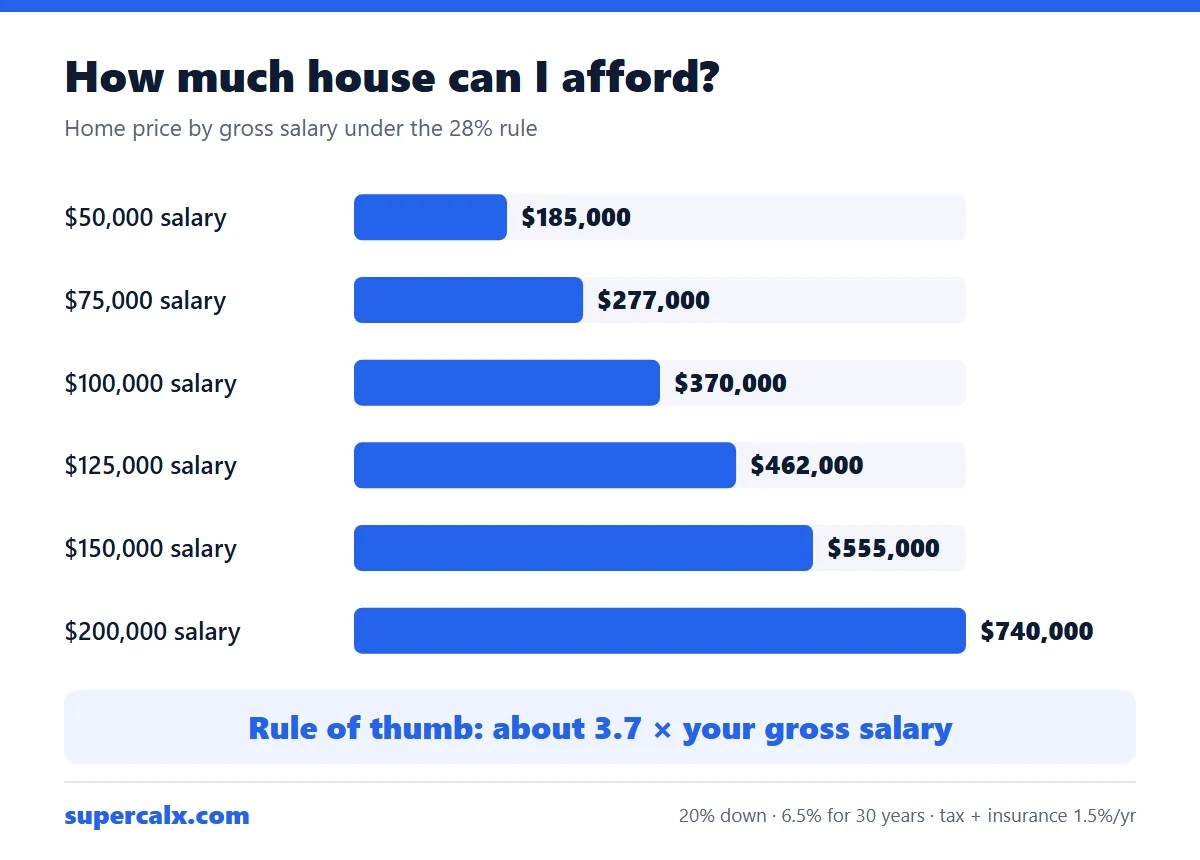 How Much House Can I Afford on My Salary?
 kW vs kWh: What Is the Difference?
 How to Calculate Take-Home Pay From Your Salary (2026)
 How Compound Interest Works (With Examples)
 How Much Gravel Do I Need for a Driveway?
 How Much Concrete Do I Need for a Slab?
 Steps to Miles Chart: How Far Is 10,000 Steps?